
Resources
Patient Treatment Kit
The Patient Treatment Kit is meant to help you get the most out of your treatment. The materials provided are not meant to replace your healthcare provider's advice. Always speak with your healthcare provider about any questions or concerns you have. Together, you and your healthcare provider can develop a personalized treatment plan based on your needs.
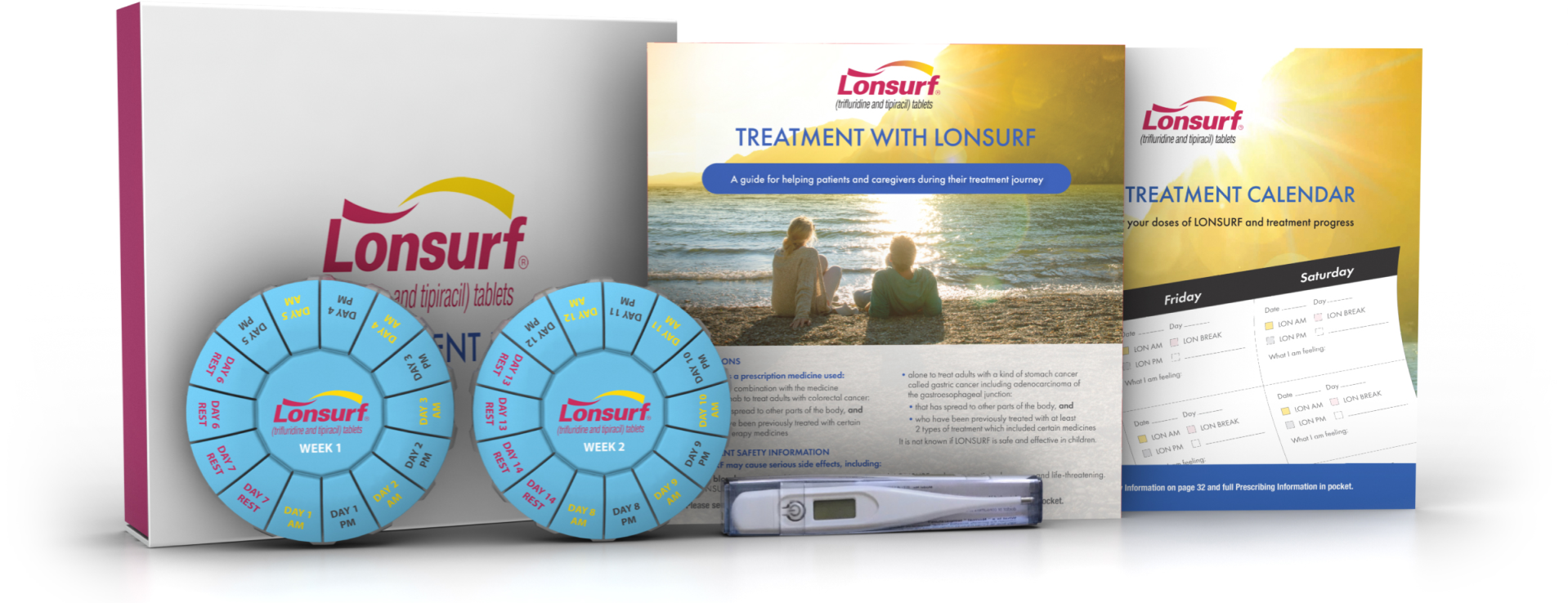
The Patient Treatment Kit includes the following items:
Patient & Caregiver Brochure
Contains information on how LONSURF can help, how to take it, tips on managing common side effects, and services that may be able to help with the cost of LONSURF. You can also download this brochure below.
LONSURF Treatment Calendar
Helps you schedule and keep track of when to take your treatment, and note any side effects or important dates
Pill Organizers
For placement of LONSURF tablets to help you keep track of your treatment
Thermometer
Encourages you to check for fever while taking LONSURF to monitor for infections
To request a Patient Treatment Kit, you can: Call 1‑844‑TAIHO‑4U (1‑844‑824‑4648)
or visit TaihoPatientSupport.com
Downloadable Resources

Patient & Caregiver Brochure
Contains information on how LONSURF can help, how to take it, tips on managing common side effects, and services that may be able to help with the cost of LONSURF.

Doctor Discussion Guide
Your doctor or nurse can help you find out whether LONSURF is right for you or your loved one. Be sure to bring this guide to your next appointment, and use the questions in it to help start the conversation.

Vibrant, healthy recipes for cancer treatment and recovery
Discover nourishing, easy‑to‑follow recipes that you can make at home, all found in the NOURISH cookbook. Inside, you will find an easy‑to‑use system of color‑coded symbols and meal prep icons designed to help you manage some of the eating challenges associated with treatment.
Talk to your doctor before making any dietary changes.
Support Groups for Colon, Rectal, and Stomach Cancer
Get the support you need for metastatic colon, rectal, or stomach cancer
Meeting and learning from other people living with colon, rectal, or stomach cancer can be helpful. Connect with others online or in a local support group.

Colontown®
Visit colontown.org
or call 1‑410‑881‑3160
Colorectal Cancer Alliance
Visit ccalliance.org
or call 1‑877‑422‑2030
Fight Colorectal Cancer
Visit fightcolorectalcancer.org
or call 1‑877‑427‑2111

Debbie's Dream Foundation
Visit
debbiesdream.org
or call
1‑855‑475‑1200
Gastric Cancer Foundation
Visit gastriccancer.org
Hope for Stomach Cancer
Visit stocan.org
or call
1‑424‑239‑9943
No Stomach for Cancer
Visit
nostomachforcancer.org
or call 1‑608‑692‑5141

CancerCare®
Visit cancercare.org
or call
1‑800‑813‑HOPE
(4673)
Cancer Support Community
Visit cancersupport
community.org
or call
1‑888‑793‑9355
GI Cancers Alliance
Visit
gicancersalliance.org
or call
1-646-598-2001
The Raymond Foundation
Visit theraymond
foundation.org
or call
1‑646‑598‑2001
Trademarks, registered or otherwise, are the property of their respective owners.
Frequently Asked Questions
Frequently Asked Questions about LONSURF
What is LONSURF?
+
−
LONSURF is an oral chemotherapy which contains two medicines in the same tablet:
- Trifluridine: May help prevent tumor growth by interfering with the tumor’s DNA
- Tipiracil: Helps trifluridine work longer
Is LONSURF chemotherapy?
+
−
Yes, it is a prescription chemotherapy tablet, taken orally.
How does LONSURF treat colorectal cancer or stomach cancer?
+
−
LONSURF includes two medicines in the same tablet:
- Trifluridine: May help prevent tumor growth by interfering with the tumor’s DNA
- Tipiracil: Helps trifluridine work longer
Why would my doctor prescribe LONSURF and bevacizumab together?
+
−
If you have advanced colon or rectal cancer, LONSURF may be used together with bevacizumab (also referred to by the brand name Avastin®), which may help slow or stop blood supply to the tumor. The use of LONSURF and bevacizumab together was approved in August 2023 based on the SUNLIGHT trial. In the trial, LONSURF with bevacizumab showed significant improvements in Overall Survival (10.8 vs. 7.5 months) and Progression-Free Survival (5.6 vs. 2.4 months).
What are the most common side effects associated with LONSURF when used alone or in combination with bevacizumab
+
−
The most common side effects of LONSURF when used alone include:
- Low blood counts, tiredness and weakness, nausea, decreased appetite, diarrhea, vomiting, stomach-area (abdominal) pain, and fever
The most common side effects of LONSURF when used in combination with bevacizumab include:
Low blood counts, tiredness and weakness, nausea, certain abnormal liver function blood tests, decreased salt (sodium) in your blood, diarrhea, stomach-area (abdominal) pain, and decreased appetite
These are not all of the possible side effects of LONSURF. For more information, ask your healthcare provider. Call your healthcare provider for medical advice about side effects.
Please see full Prescribing Information.
How is LONSURF taken?
+
−
LONSURF is taken twice a day with food - the type of food does not matter. Do not retake doses of LONSURF that are vomited or missed and continue with the next scheduled dose.
LONSURF comes in 2 strengths: 15mg and 20mg tablets.* Your healthcare provider may prescribe both strengths for your prescribed dose.
What is the LONSURF Dosing Schedule?
+
−
LONSURF dosing schedule:
- You will take LONSURF twice a day (with morning and evening meals) for 5 days, and then rest for the next 2 days. This goes on for 2 weeks. Then you will not take LONSURF for 2 weeks (14 days). This completes the 28-day LONSURF treatment cycle.
- This is repeated for as long as your healthcare provider says. Always follow all of your healthcare provider’s directions carefully.
Create a personalized treatment calendar at LONSURF.com/mycalendar to help you schedule and keep track of your treatment. Your healthcare provider may give you a treatment calendar as well.
How is bevacizumab administered when prescribed with LONSURF?
+
−
For most patients with colorectal cancer, LONSURF may be prescribed to be used with bevacizumab. Bevacizumab is given as an infusion once every 2 weeks (on Days 1 and 15 of your LONSURF treatment cycle) by a doctor or nurse.
What should I do if I vomit after taking LONSURF?
+
−
Do not retake doses of LONSURF that are vomited or missed and continue with the next scheduled dose. Tell your healthcare provider if you have nausea or vomiting that gets worse or does not go away.
How should LONSURF be stored and handled?
+
−
Store LONSURF at room temperature between 68°F to 77°F (20°C to 25°C). Do not store LONSURF with other medicines. Keep LONSURF in its own container. If you store your tablets outside of the original container, any unused LONSURF tablets should be disposed of after 30 days.
Wash your hands after handling LONSURF. Even though it is a pill, it is still chemotherapy. Make sure your caregiver wears gloves when handling LONSURF. Note that there is a packet inside the bottle that helps absorb moisture. Do not swallow this material. Keep LONSURF out of the reach of children.
What if my loved one or I have a question about LONSURF, and the doctor's office is not available?
+
−
To get answers to your questions about LONSURF, contact us at 1‑844‑TAIHO‑4U (1‑844‑824‑4648).
Does Taiho Oncology offer any financial assistance programs?
+
−
Yes. Taiho Oncology Patient Support is here to help you obtain access to your Taiho Oncology Medicine. Our program offers a benefits review to confirm coverage, co-pay assistance enrollment for eligible patients to receive a LONSURF copay card which may reduce co-pay responsibility to $0, specialty pharmacy prescription coordination, and personalized nurse support for patients taking LONSURF.
For more information about LONSURF financial support, call 1‑844‑TAIHO‑4U (1‑844‑824‑4648) or go to TaihoPatientSupport.com.
Why would my doctor change my LONSURF treatment plan?
+
−
Your doctor may change your LONSURF treatment plan for various reasons including:
- adjusting your dosage due to side effects you may be experiencing such as a decrease in white blood cells, red blood cells, or platelets, or if you experience other serious side effects.
- adding bevacizumab (also known as Avastin) to be used in combination with LONSURF which the SUNLIGHT clinical trial showed meaningfully improvements in treatment outcomes.
Talk to your healthcare provider about any changes to your treatment plan.
How could my doctor change my LONSURF treatment plan?
+
−
There are 3 ways your doctor may change your treatment plan. It is not uncommon to receive a change in your treatment plan. In each case, your doctor may first delay your treatment. Delaying your treatment is an important step your doctor may take before deciding whether to:
- Resume your LONSURF treatment at the same dose
- Resume your LONSURF treatment at a lower dose
- Stop your LONSURF treatment permanently
How could low white blood cell counts affect me and my LONSURF treatment?
+
−
Low white blood cell counts can make you more likely to get serious infections. Serious infections could be fatal. Your doctor may change your treatment to prevent blood cell counts from lowering to a dangerous level.
Tell your doctor right away if you develop any signs of infection such as fever, chills, or body aches. You can use the thermometer in the Treatment Kit to check your temperature each day.
Does LONSURF cause hair loss?
+
−
Every patient can react differently to therapy. However, when LONSURF was used as a single agent, 7% of patients experienced some sort of alopecia (also known as hair loss) compared to 1% of patients receiving placebo.
What is metastatic colon or rectal cancer?
+
−
Colon and rectal cancer are often referred to as colorectal cancer. It includes cancer that starts in the colon or rectum, which are both parts of the lower digestive system. Metastatic means that the cancer has spread to other parts of the body. Together, colon and rectal cancer are the fourth most common in the United States among men and women.
What is metastatic stomach or gastroesophageal junction cancer?
+
−
Stomach cancer is often referred to as gastric cancer. It includes cancer that starts to grow in the lining of the stomach. A similar type of cancer is gastroesophageal junction cancer (also known as GE Junction or GEJ). This is cancer that starts to grow in the place where the esophagus and the stomach meet. Metastatic means that the cancer has spread to other parts of the body. While it is less common in the United States, stomach cancer is the fifth most common cancer in the world.